
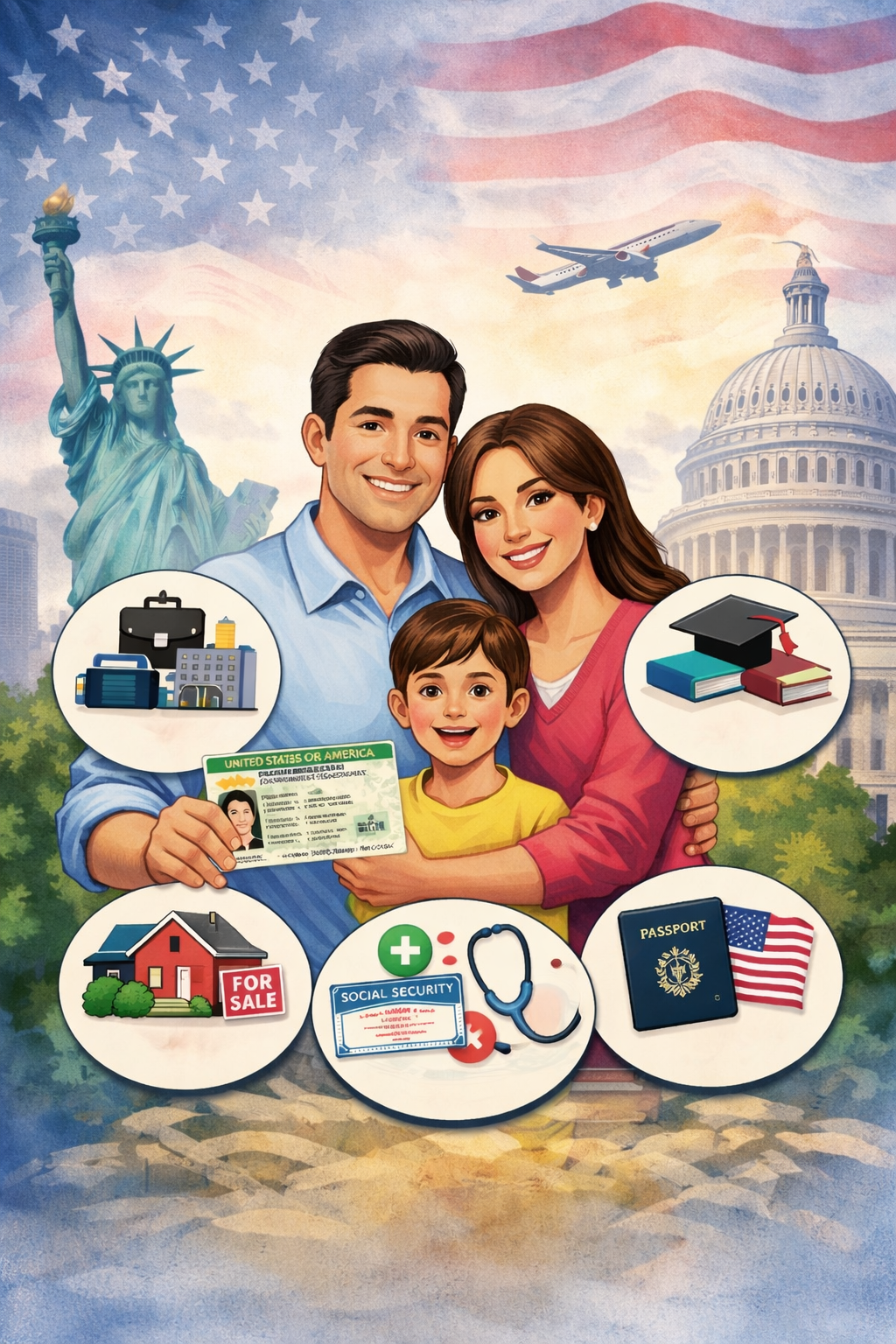
USA Permanent Resident Rights and Benefits explain the key privileges and responsibilities of Green Card holders who are legally allowed to live and work in the United States on a long-term basis. Permanent residency gives foreign nationals the security to build a life in the U.S. while remaining one step below full citizenship.
Meaning and Explanation of USA Permanent Residency
A U.S. Permanent Resident, commonly called a Green Card holder, is a non-U.S. citizen who has been officially authorized to live and work in the United States on a permanent basis. This status is granted through U.S. immigration laws under different categories such as family sponsorship, employment, investment, refugee or asylum status, and other special programs.
Permanent residency is different from temporary nonimmigrant visas (like H1B, L1, F1, or B1/B2). Temporary visa holders must maintain a specific purpose (such as study, tourism, or a particular job), and in many cases, they must leave the U.S. when that purpose ends or the visa expires. Green Card holders, on the other hand, can remain in the U.S. indefinitely as long as they obey the law and do not abandon their residence.
The Green Card itself is a physical identity document that usually needs renewal every 10 years, but the status of being a permanent resident does not expire unless it is lost through serious violations, long-term absence, or formal abandonment. Only an immigration judge or certain legal processes can formally take away permanent resident status.
In simple terms, U.S. permanent residency shows that the U.S. government trusts you to live, work, and participate in American society over the long term, with a clear path to citizenship if you choose to pursue it.
According to the U.S. Citizenship and Immigration Services (USCIS) , a permanent resident is a non-citizen authorized to live and work permanently in the United States.
Why USA Permanent Resident Rights and Benefits Matter
Understanding USA Permanent Resident Rights and Benefits is crucial because many immigrants either underestimate their freedoms or misunderstand their obligations once they receive a Green Card. Some continue to behave like temporary visa holders and miss out on opportunities, while others accidentally violate rules and risk losing their status.
Permanent residency directly affects important areas of life such as:
- Career opportunities and job mobility in the U.S. labor market.
- Income stability, retirement planning, and Social Security eligibility.
- Family security through sponsorship of spouses and children.
- Access to public benefits, healthcare, and education support.
- Long-term path to U.S. citizenship and political rights.
When Green Card holders know their rights, they can take advantage of better jobs, education benefits, and legal protections. When they understand their limitations, they can avoid serious mistakes like long trips abroad, not filing taxes, or ignoring criminal charges, which might trigger removal proceedings or denial of future citizenship.
For families, permanent residency provides a more stable foundation than a temporary visa. Children can grow up without worrying that their parents’ visa might suddenly end, and the entire family can plan for property ownership, higher education, and long-term settlement in the U.S.
Additional official guidance for permanent residents is available on USA.gov’s immigration and citizenship resource page , which explains rights, responsibilities, and public services.
How USA Permanent Residency Works (With Practical Example)
The journey to becoming a permanent resident can be long and complex, but it typically follows three broad stages: eligibility, application and processing, and final approval with Green Card issuance.
1. Eligibility
To apply for a Green Card, the applicant must fall into at least one eligible category, such as:
- Family-based sponsorship: Spouses, children, parents, or certain relatives of U.S. citizens and permanent residents.
- Employment-based immigration: Skilled workers, professionals, researchers, managers, and investors, typically under EB-1 to EB-5 categories.
- Diversity Visa (DV) Lottery: Applicants from countries with low immigration rates to the U.S.
- Refugee or asylum status: Protection-based paths for people facing persecution.
- Special immigrant categories: Religious workers, certain international employees, and other defined groups.
To understand how work visas relate to later permanent residency, you can also refer to USA Work Visa Application Process and L1 Visa vs H1B Visa.
2. Application and Approval Process
Once eligibility is clear, the process typically involves:
- Submitting a petition (for example, Form I-130 for family or Form I-140 for employment) to USCIS.
- Waiting for the petition to be approved and for a visa number to become available, based on category and priority date, especially where backlogs exist.
- Filing either Adjustment of Status (if the applicant is already in the U.S.) or going through consular processing at a U.S. embassy or consulate abroad.
- Completing biometrics, background checks, and a medical exam.
- Attending the Green Card interview, where an officer verifies the information and eligibility. For preparation strategies, see Green Card Interview Questions Preparation Guide.
3. Green Card Issuance
If the interview and documentation satisfy USCIS or the consular officer, the application is approved and the applicant becomes a permanent resident. Those already in the U.S. receive a new status and, later, the Green Card by mail; those abroad receive an immigrant visa and enter the U.S. as a permanent resident from day one.
Real-Life Example
Rahul, an IT professional from India, comes to the U.S. on an H1B work visa. Over time, his employer files an employment-based immigrant petition for him. After PERM labor certification, I-140 approval, and waiting for his priority date due to backlogs, Rahul finally files Adjustment of Status. He attends his interview, gets approval, and receives his Green Card. As a permanent resident, he can now:
- Change employers without worrying about H1B transfer rules.
- Start his own consulting company if he wishes.
- Plan to buy a home and sponsor his spouse and children for Green Cards.
If his case had been denied in error or due to a misunderstanding, he might have considered using options explained in the USA Immigration Appeal Process.
Major Benefits of USA Permanent Resident Status
Green Card holders enjoy many powerful benefits under U.S. law, often similar to U.S. citizens in daily life, though not identical. Below are the most important advantages permanent residents typically receive.
1. Right to Live Permanently in the U.S.
Permanent residents can live in any U.S. state or territory with no time limit, as long as they do not commit actions that make them removable (deportable) under immigration law. They can change their place of residence freely within the U.S. and are protected by federal, state, and local laws.
2. Freedom to Work
Green Card holders can work at almost any job that suits their skills and qualifications, even switching employers, industries, or locations without needing new sponsorship or work permits. They may also start a business, become self-employed, or take multiple jobs, as long as they follow employment laws.
3. Access to Education and In-State Tuition
Permanent residents can attend public schools, colleges, and universities, and in many states, qualify for in-state tuition, which is significantly cheaper than international tuition rates. They may also be eligible for certain federal or state financial aid, scholarships, and student loans, depending on specific program rules.
4. Social Security and Retirement Benefits
After working and contributing Social Security taxes for enough quarters (typically 10 years of work), permanent residents can receive Social Security retirement benefits, disability benefits, or survivor benefits for their family members if they meet the requirements. Many Green Card holders plan long-term retirement in the U.S. with these benefits in mind.
5. Healthcare and Public Benefit Access
Green Card holders can enroll in private health insurance, employer-sponsored plans, or Affordable Care Act marketplace plans. After meeting specific residency and income rules, some may access public healthcare programs and other support programs, although eligibility and waiting periods vary by state and by program.
6. Property Ownership and Financial Opportunities
Permanent residents can buy, sell, and invest in real estate across the U.S., as well as open bank accounts, build credit histories, and apply for loans and mortgages, often on similar terms as citizens. This allows them to build wealth and financial stability over time.
7. Family Sponsorship Rights
Green Card holders may sponsor certain family members, especially spouses and unmarried children, to become permanent residents themselves. While waiting times can exist depending on the category and the applicant’s country of origin, this is a key way to reunite families in the U.S.
8. Legal Protection Under U.S. Law
Permanent residents are protected by U.S. constitutional rights and laws, including labor protections, anti-discrimination laws, and access to courts. They can sue and be sued in U.S. courts and are entitled to due process of law before the government can attempt to remove them from the country.
9. Travel Flexibility
Green Card holders can travel outside the U.S. and return, as long as they do not stay outside for so long or in such a way that it appears they have abandoned their residence. Short trips (under six months) are normally safe, but longer or repeated absences should be carefully planned, possibly using a reentry permit.
10. Path to U.S. Citizenship
After usually five years of continuous permanent residence (or three years if married to a U.S. citizen and meeting additional rules), a Green Card holder can apply to become a U.S. citizen through the naturalization process. Citizenship brings additional rights such as voting in federal elections and holding certain government jobs.
Risks and Limitations of USA Permanent Residency
Despite the many advantages, permanent residency is not the same as citizenship and does have important limitations and risks.
1. No Voting in Federal Elections
Permanent residents cannot vote in U.S. federal elections (President, Congress) or most state-level elections. Voting when you are not eligible can be treated as a serious immigration violation and may lead to deportation or denial of future citizenship.
2. Maintaining Residency
Green Card holders must treat the U.S. as their primary home. Spending too much time outside the country, especially more than six months at a time or more than one year without a reentry permit, can raise questions about whether you have abandoned your status. Maintaining a U.S. address, filing resident tax returns, and keeping strong ties are all important.
3. Criminal and Immigration Violations
Certain crimes, even if they seem minor, can be considered “crimes involving moral turpitude” or aggravated felonies and can make a person removable from the U.S. Drug offenses, fraud, domestic violence, and some theft or assault crimes are especially dangerous for immigration status.
4. Limited Access to Certain Government Jobs
Some jobs in federal agencies, law enforcement, and national security roles are reserved only for U.S. citizens. Green Card holders may find their access limited in these areas, although they can work in many other public and private sector roles.
5. Green Card Renewal Obligations
Although permanent residence itself does not expire, the physical Green Card typically must be renewed every 10 years by filing a form and paying a fee. Conditional Green Cards based on recent marriage or investment usually last for 2 years and require additional steps to remove conditions. Failing to renew does not automatically cancel status, but it can cause practical problems in proving your legal residency.
Common Mistakes and Myths About Permanent Resident Rights
Myth 1: Green Card Equals Citizenship
Many people assume that having a Green Card gives them the same rights as citizens. This is not true. Permanent residents cannot vote in federal elections, hold certain government offices, or apply for some security-sensitive jobs. They can also be placed into removal proceedings for certain violations, which citizens cannot.
Myth 2: You Can Stay Outside the U.S. for Years Without Issues
Spending a very long time outside the U.S. can suggest that you no longer intend to live permanently in the United States. Long or frequent trips may break the continuity required for future citizenship and may even lead to questions at the port of entry or in court about whether you abandoned your residence.
Mistake 1: Not Filing U.S. Tax Returns
Permanent residents are generally treated as U.S. tax residents and must file U.S. tax returns on their worldwide income, even if they live abroad temporarily. Filing as a “non-resident” or failing to file at all can hurt both your tax situation and your immigration status.
Mistake 2: Ignoring Address Update Requirements
Green Card holders must inform USCIS of any change of address within a set period (usually 10 days) using the designated form or online system. Not doing so is a violation of immigration law, even if it seems minor, and can cause trouble later.
Mistake 3: Assuming Minor Criminal Charges Don’t Matter
Some permanent residents do not take minor charges or guilty pleas seriously, but certain offenses can have major immigration consequences. Before pleading guilty to any crime, it is important to consult both a criminal defense lawyer and an immigration attorney.
How to Maintain and Protect Your Permanent Resident Status
Because permanent residency can be lost, it is important to follow best practices to protect it.
- Keep the U.S. as your main home and avoid long absences without proper planning.
- File U.S. tax returns every year as required and keep clear records.
- Renew your Green Card before it expires and carry proof of your status when required.
- Follow all federal, state, and local laws, including traffic and criminal laws.
- Seek legal advice quickly if you face criminal charges, immigration notices, or long-term travel plans.
If your application, status, or benefit is denied and you believe the decision is incorrect, you may be able to use options described in the USA Immigration Appeal Process to challenge the decision.
Path to U.S. Citizenship from Permanent Residency
For many Green Card holders, the ultimate goal is to become a U.S. citizen. After holding permanent resident status for typically five years (or three years for certain spouses of U.S. citizens), and meeting physical presence, continuous residence, and good moral character requirements, a permanent resident can apply for naturalization.
Once approved and sworn in as a citizen, a person gains additional rights such as voting in all elections, obtaining a U.S. passport, and sponsoring a wider range of family members for Green Cards, often with faster processing. However, citizenship also carries duties, such as serving on a jury and continuing to obey all laws.
FAQ: USA Permanent Resident Rights and Benefits
1. Can a permanent resident work anywhere in the U.S.?
Yes. Green Card holders may generally work for any employer, in almost any legal job, or even run their own business without needing special work authorization.
2. Can permanent residents sponsor family members?
Yes. Permanent residents can sponsor spouses and unmarried children under specific family preference categories, although waiting times vary based on country and visa demand.
3. How long can a permanent resident stay outside the U.S.?
Trips shorter than six months are usually safe, but frequent or longer trips can raise questions. Trips over one year without a reentry permit often risk a finding of abandonment.
4. Do permanent residents pay U.S. taxes?
Yes. In most cases, permanent residents are required to file U.S. tax returns on their worldwide income and should not file as non-residents unless advised by an expert who understands immigration consequences.
5. Can permanent residents receive Social Security and Medicare?
Yes. If they have worked long enough and paid into the system, they may qualify for Social Security retirement, disability, and survivor benefits, and later for Medicare coverage.
6. Can permanent residents become U.S. citizens?
Yes. After meeting residency and eligibility requirements, many Green Card holders can apply for naturalization and obtain full citizenship rights.
7. Can a Green Card be revoked?
Yes. A Green Card can effectively be lost through serious criminal offenses, immigration fraud, long-term absence suggesting abandonment, or certain tax and residency issues. Only a judge or lawful process can terminate the status.
Conclusion
Understanding USA Permanent Resident Rights and Benefits is essential for anyone holding or seeking a Green Card. Permanent residency offers powerful advantages—freedom to live and work, financial and educational opportunities, family sponsorship, legal protection, and a pathway to citizenship—while also imposing obligations such as maintaining residence, filing taxes, and respecting U.S. laws.
Used wisely, a Green Card becomes a strong foundation for a secure and successful future in the United States. Combining this knowledge with professional legal advice, careful planning, and resources like the guides at LawGuideNow helps immigrants make informed decisions at every step.
Disclaimer: The information provided in this article is for general informational and educational purposes only and does not constitute legal, immigration, financial, or professional advice. U.S. immigration laws, policies, and procedures are complex and subject to change at any time. Reading or using this content does not create an attorney–client relationship. For advice specific to your situation, you should consult a qualified immigration attorney or authorized legal professional before making any decisions or taking action.
Pingback: Work Accident Compensation Rules: Eligibility, Benefits & FAQs
Pingback: Types of USA Work Visas Explained in Simple Language