
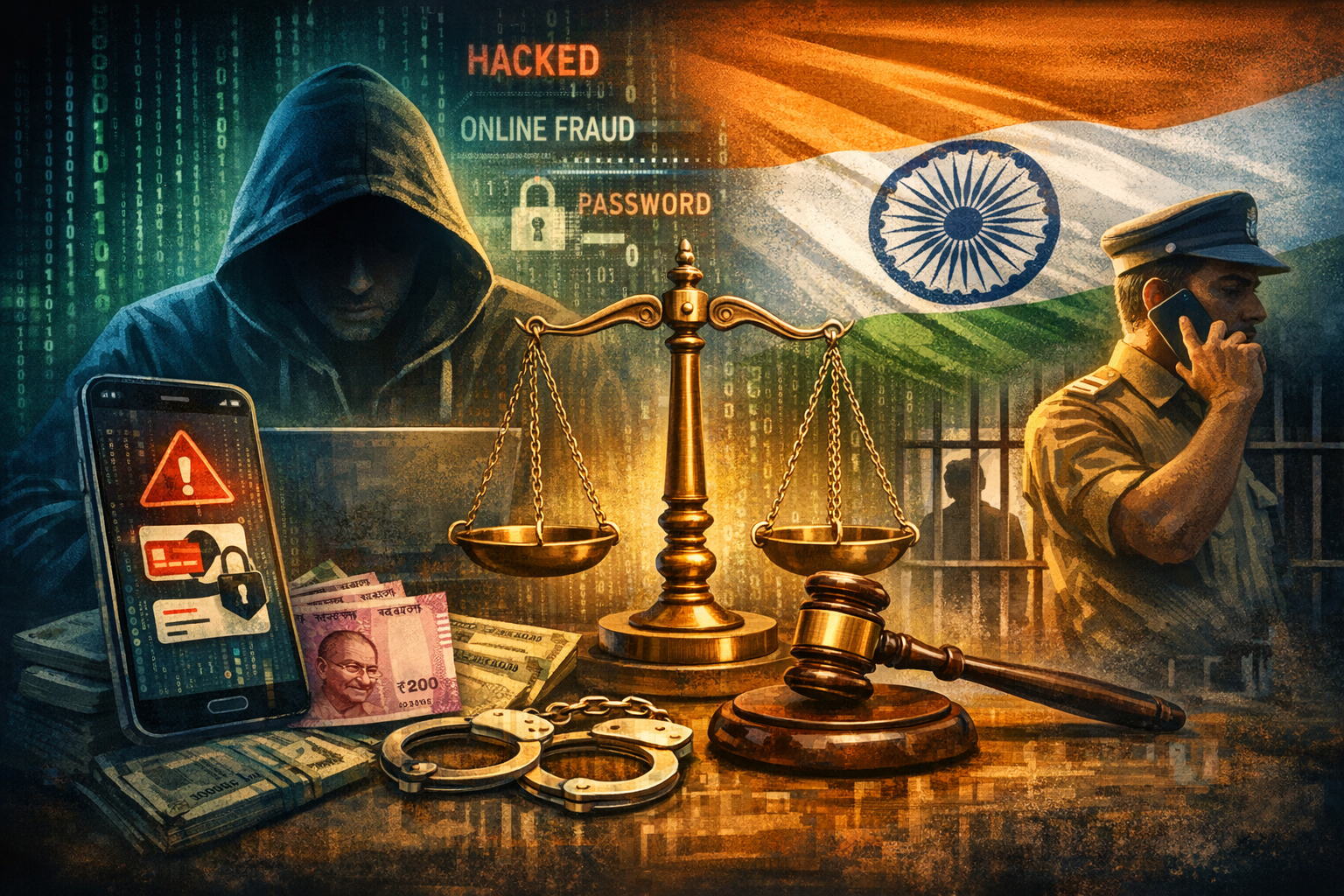
Online Fraud Law Punishment in India
Online fraud law punishment in India combines the Information Technology Act, 2000 (IT Act), Indian Penal Code (IPC), and financial regulations to address cybercrimes. These laws impose penalties from fines to life imprisonment, depending on the offense severity.
With cyber fraud losses exceeding ₹52,000 crore from 2020–2025, strict enforcement protects India’s digital economy.
Meaning of Online Fraud
Online fraud involves dishonest acts using the internet or digital devices to deceive victims for financial gain or data theft. Indian law covers it under the IT Act, 2000, and IPC sections without a single definition.
Common types include phishing, where fraudsters trick users into revealing bank details, and identity theft via stolen credentials. Emerging threats like deepfake scams and AI-generated impersonation now challenge investigators.
Courts view these offenses as serious economic crimes because they erode trust in UPI, e-commerce, and digital banking. Investment scams, credit card fraud, fake loan apps, and UPI “payment request” tricks are among the most frequently reported categories of cyber fraud in recent years.
Key Legal Provisions for Online Fraud
Information Technology Act, 2000
The IT Act, 2000 is the primary cyber law framework in India. It defines offenses related to unauthorized access, data theft, hacking, identity misuse, and online cheating.
- Section 43 – Unauthorized access, data theft, or damage to computer systems
- Penalty: Compensation up to ₹1 crore or more, depending on actual damage or loss suffered by the victim.
- Section 66 – Computer-related offenses involving dishonest or fraudulent intention
- Punishment: Imprisonment up to 3 years and/or fine up to ₹5 lakh.
- Section 66C – Identity theft (unauthorized use of passwords, digital signatures, or other unique identification features)
- Punishment: Imprisonment up to 3 years and fine up to ₹1 lakh.
- Section 66D – Cheating by personation using computer resources (for example, fake bank or UPI support calls/chats)
- Punishment: Imprisonment up to 3 years and fine up to ₹1 lakh.
- Section 66F – Cyber terrorism (attacks aimed at critical infrastructure, national security, or large-scale panic)
- Punishment: Imprisonment which may extend to life.
In addition, provisions such as Section 69 and 69B deal with monitoring and interception of data by authorized agencies for security and investigation purposes, subject to legal safeguards.
Indian Penal Code (IPC), 1860
Many online frauds are also punishable under traditional criminal law provisions of the IPC, especially those dealing with cheating, forgery, and criminal breach of trust.
- Section 420 – Cheating and dishonestly inducing delivery of property
- Punishment: Imprisonment up to 7 years and fine.
- Section 468 – Forgery for the purpose of cheating (for example, forging electronic documents, e-mails, or digital contracts)
- Punishment: Imprisonment up to 7 years and fine.
- Section 471 – Using forged document or electronic record as genuine
- Punishment: Same as the punishment for forgery involved.
In large-scale financial frauds, provisions of the Companies Act, 2013 (Section 447 – punishment for fraud) and Prevention of Money Laundering Act (PMLA) may also apply, leading to harsher penalties, attachment of properties, and longer imprisonment.
How Online Fraud Cases Work in Practice
Online fraud cases are generally handled by specialized Cyber Crime Cells within state police or central agencies. The process usually includes:
- Filing a complaint – Victims can report incidents at a local police station, cyber police station, or through the National Cyber Crime Reporting Portal (Cyber Crime Portal).
- Registration of FIR – Based on the facts, the police register an FIR under relevant sections of the IT Act and IPC.
- Investigation – Cyber experts trace IP addresses, recover digital evidence, analyze bank trails, and identify beneficiaries of fraudulent transactions.
- Charge sheet and trial – Once investigation is complete, a charge sheet is filed in court, followed by trial, conviction, and sentencing if guilt is proven.
Example Scenario
Suppose a victim receives a fake SMS claiming to be from their bank asking to update KYC by clicking a link. After entering login and UPI PIN on a fake site, ₹2 lakh is transferred out of their account without consent.
In such a case, the following provisions may apply:
- IT Act, 2000 – Section 66C (identity theft) and Section 66D (cheating by personation using computer resources).
- IPC, 1860 – Section 420 (cheating and dishonestly inducing delivery of property).
The accused, if arrested and convicted, may face imprisonment up to 7 years under IPC along with additional punishment under the IT Act, plus fines. In larger organized scams, courts may consider the overall magnitude of fraud, number of victims, and repeat offending while deciding sentence.
Why Strong Online Fraud Punishment Matters
As India moves toward a cashless and “Digital India” ecosystem, the number of online transactions has exploded. UPI, net banking, card payments, and mobile wallets are now routine for ordinary citizens, businesses, and even government benefits.
Strict punishment for online fraud is important because it:
- Protects citizens from financial loss, identity theft, and emotional distress.
- Maintains trust in online banking, UPI, and digital payment systems.
- Discourages misuse of new technologies like AI chatbots, deepfakes, and social media tools for scams.
- Ensures accountability of cybercriminals, intermediaries, and sometimes negligent service providers.
- Strengthens India’s image as a safe digital economy globally.
Without effective legal consequences, professional cybercriminals and cross-border fraud networks would treat Indian users as easy targets, shifting large-scale fraud operations online.
Benefits of Strong Cyber Laws and Enforcement
India’s cyber law framework, when properly implemented, offers important benefits:
- Legal protection – Victims can seek criminal action and, in many cases, compensation for their losses through courts or consumer forums.
- Faster grievance redressal – Dedicated cyber cells and the national portal help streamline complaints and reduce delays in registration.
- Deterrence – Publicized convictions and strict sentences discourage others from engaging in similar online frauds.
- Support for digital growth – Strong legal backing encourages people and businesses to adopt digital payments and e-commerce with greater confidence.
- International cooperation – Robust laws make it easier for India to cooperate with other countries and international bodies on cross-border cybercrime investigations.
For genuine businesses and start-ups, clear legal standards also provide guidance on compliance and data protection, reducing the risk of accidental violations.
Risks and Limitations of Online Fraud Laws
Despite having robust laws on paper, several practical challenges still limit effectiveness:
- Low awareness – Many users are unaware of basic cyber hygiene practices and legal remedies, so they become repeated targets.
- Underreporting – Victims often do not report fraud due to embarrassment, small amounts, or the belief that “nothing will happen”.
- Delay in investigations – Technical complexity, lack of skilled investigators, and heavy caseloads slow down case resolution.
- Jurisdiction issues – Fraudsters may operate from different states or countries, making coordination more complicated.
- Digital evidence challenges – Evidence can be quickly deleted, altered, or stored on foreign servers, complicating proof.
Timely reporting, proper documentation, and cooperation from banks, telecom companies, and intermediaries are crucial to overcome these limitations.
How to Report Online Fraud in India
Victims do not need to visit a police station immediately in every case. The Government of India has set up an online portal to make reporting easier.
1. National Cyber Crime Reporting Portal
You can report online fraud at the official portal:
Basic steps include:
- Visit the portal and select “Report Other Cyber Crime” or “Report Financial Fraud” based on your case.
- Fill in your personal details, incident description, and approximate date and time.
- Attach supporting evidence such as screenshots of messages, fraudulent links, call recordings (if any), and bank transaction details.
- Submit the complaint and note the reference number for future tracking.
- Follow up with your local cyber police station if you receive instructions or if the matter is urgent.
2. Bank / Financial Institution Reporting
For online banking, UPI, or credit card fraud, always inform your bank or service provider immediately through their official customer care number or branch. Many banks have zero-liability or limited-liability policies if fraud is reported quickly.
Useful guides on complaint processes:
- Credit Card Fraud – Legal Complaint Process
- Cyber Crime Complaint Process – Step by Step
- How to File a Cyber Crime Complaint Online
These resources explain how to preserve evidence, whom to approach first, and how to draft effective complaints.
Common Mistakes and Myths About Online Fraud Law
- Myth: Small fraud amounts are not punishable.
Reality: Even if the cheated amount is small, the act itself is a criminal offense. Offenders can still be prosecuted under IT Act and IPC sections. - Myth: Only banks or payment apps are responsible for online fraud.
Reality: Banks have duties to secure systems, but users must also protect passwords, PINs, and OTPs. Sharing sensitive details voluntarily can weaken your claim. - Myth: Online fraud cannot be traced because everything is “virtual”.
Reality: Digital footprints such as IP addresses, device IDs, transaction logs, and KYC details often lead to identification and arrest of fraudsters. - Mistake: Delaying the complaint because of confusion or fear.
Delays reduce the chances of freezing funds or tracing culprits. Always report as soon as possible.
Prevention Tips for Citizens and Businesses
Legal punishment is important, but prevention is even more powerful. Some practical safety measures include:
- Never share OTPs, PINs, CVV, or full card numbers with anyone, even if they claim to be from a bank or government.
- Type official URLs manually or use bookmarked links instead of clicking random links from SMS, e-mail, or social media.
- Enable two-factor authentication (2FA) for bank, UPI, and important e-mail/social media accounts.
- Regularly monitor your bank and card statements to detect suspicious transactions early.
- Educate family members, especially children and senior citizens, about common scam patterns.
- Install security updates, use strong passwords, and avoid installing unverified apps.
- Immediately block cards or freeze accounts if you suspect compromise and then file a formal complaint.
Frequently Asked Questions (FAQ)
1. What is the punishment for online fraud in India?
Punishment ranges from fines and compensation orders to imprisonment up to 7 years or more, depending on the sections involved. In serious cases like cyber terrorism or large-scale organized fraud, imprisonment may extend to life or 10 years plus heavy fines.
2. Which law covers online fraud in India?
Online fraud is mainly covered under the Information Technology Act, 2000 (especially Sections 43, 66, 66C, 66D, 66F) and relevant provisions of the Indian Penal Code, 1860 (such as Sections 420, 468, 471). In corporate or money laundering cases, the Companies Act and PMLA may also apply.
3. Can online fraud be reported online?
Yes. Online fraud can be reported through the National Cyber Crime Reporting Portal at cybercrime.gov.in, in addition to approaching the local cyber police station.
4. Is UPI fraud punishable under Indian law?
Yes. UPI fraud is treated as a form of online cheating and is punishable under IT Act provisions such as Section 66C and 66D, along with IPC Section 420 for cheating and dishonestly inducing delivery of property.
5. Can victims recover lost money?
Recovery is not guaranteed but is more likely if the victim reports quickly to the bank and police. Banks may be able to freeze or recall funds in some cases, and courts can order restitution or compensation during trial or through separate civil proceedings.
6. Is online fraud a criminal offense?
Yes. Online fraud is a serious criminal offense, not just a civil dispute. Convicted persons may face imprisonment, fines, and other legal consequences such as seizure of assets.
7. What evidence is required to prove online fraud?
Useful evidence includes screenshots of chats, e-mails, websites, fake profiles, SMS, call logs, bank statements, transaction IDs, and any documents or recordings that show the fraudulent act and resulting loss.
8. Are minors punishable for online fraud?
Yes, but minors (below 18 years) are dealt with under the Juvenile Justice (Care and Protection of Children) Act. The focus is more on reform and rehabilitation, though serious offenses can still lead to stringent measures.
9. Where can online fraud be reported?
Online fraud can be reported at cybercrime.gov.in, local police stations, or specialized cyber police stations. Banks and payment service providers should also be informed immediately.
Authoritative External Resources
- National Cyber Crime Reporting Portal
- Reserve Bank of India – Digital Payment Safety
- Information Technology Act, 2000 (India Code)
- Ministry of Home Affairs – Cyber Security
- Credit Card Fraud – Legal Complaint Process
- Cyber Crime Complaint Process – Step by Step
- File Cyber Crime Complaint Online
Legal Disclaimer
Disclaimer: The information provided in this article is for general informational and educational purposes only. It does not constitute legal advice, financial advice, or professional consultation.
Laws relating to online fraud, cyber crime, and punishment in India may change over time and can vary based on specific facts, jurisdiction, and interpretation by courts. While every effort has been made to ensure accuracy, no guarantee is given regarding the completeness or current validity of the information.
Readers are advised not to rely solely on this content for making legal or financial decisions. For advice specific to your situation, please consult a qualified advocate, cyber law expert, or appropriate legal authority.
The website and author shall not be liable for any loss, damage, or consequences arising from the use of or reliance on the information contained in this article.
Pingback: How to File a Cyber Crime Complaint Online (2026 Full Guide)