
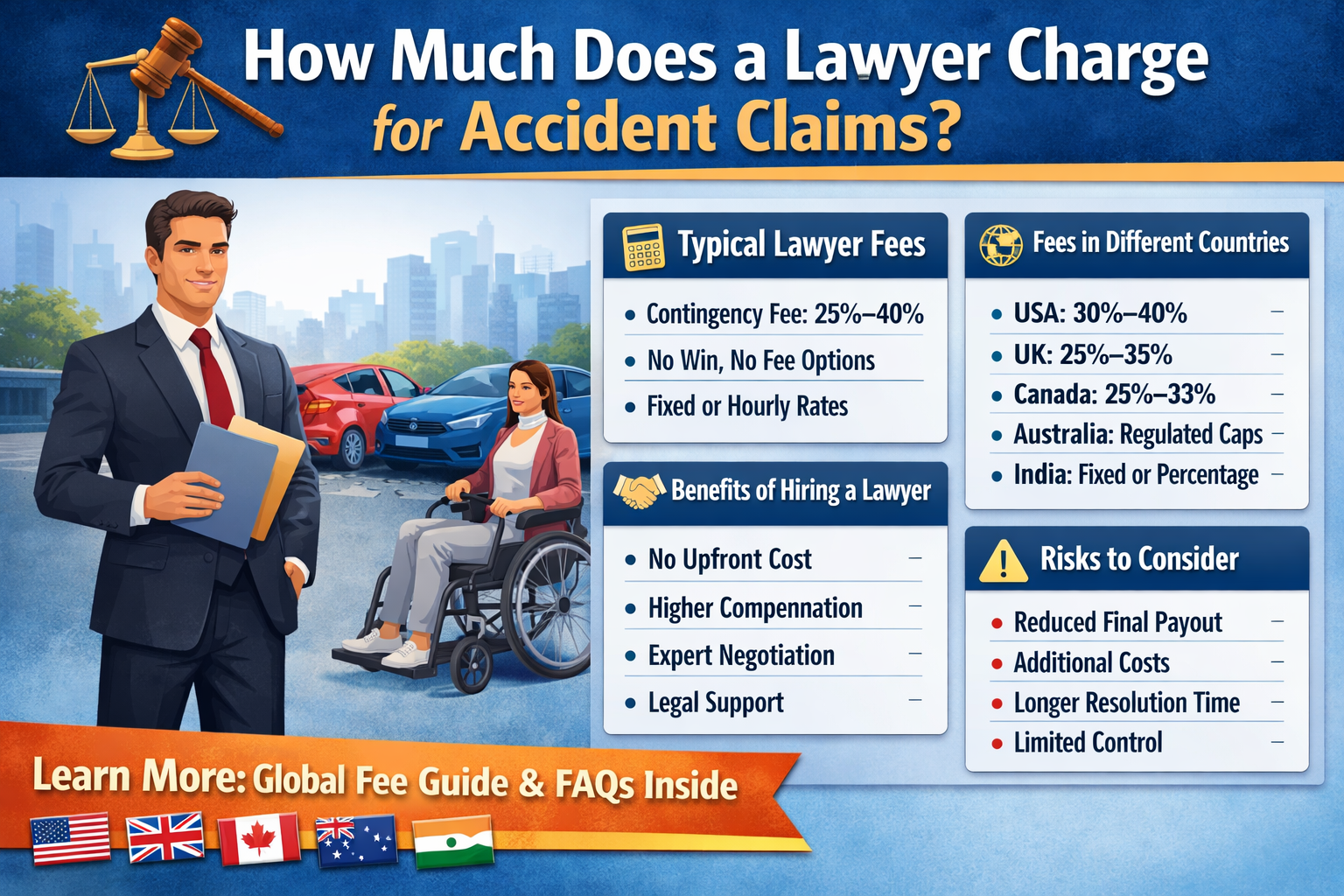
How much does a lawyer charge for accident claims? This is one of the most common questions people ask after being injured in a car accident, workplace incident, slip-and-fall, or other personal injury case. In many countries, accident lawyers work on a contingency or “no win, no fee” basis, meaning you only pay if you receive compensation.
This beginner-friendly guide explains accident lawyer fees in a clear and global context. You’ll learn how lawyer charges work, typical percentages worldwide, real-life examples, hidden costs, benefits, risks, common myths, and FAQs—so you can confidently understand legal costs before hiring a lawyer.
Meaning / Explanation: What Does a Lawyer Charge for Accident Claims?
Accident claims involve seeking financial compensation for injuries, medical expenses, lost income, property damage, and emotional suffering caused by someone else’s negligence or wrongful act. To handle these claims, most people hire a personal injury or accident lawyer to negotiate with insurers or represent them in court when necessary.
Globally, accident lawyers typically charge fees using one of the following models:
- Contingency Fee: A percentage of the compensation awarded, often between 25% and 40% in many personal injury systems.
- No Win, No Fee: Common in the UK and several Commonwealth countries, where a capped success fee is deducted only if the claim succeeds.
- Fixed or Negotiated Fees: Used in some Asian and Middle Eastern countries, especially where pure contingency arrangements are restricted or prohibited by law.
- Hourly Fees: Less common for standard accident claims but sometimes used in complex, commercial, or professional negligence matters.
The most common and accessible model worldwide is the contingency fee system, particularly in countries like the United States and Canada. Under this system, the lawyer only gets paid if the case is successful, which allows injured victims to pursue claims even if they cannot afford to pay legal fees upfront.
Typical contingency fees range between 25% and 40%, depending on the jurisdiction, case complexity, risk involved, and whether the claim settles early or goes all the way to trial or appeal.
Why It Matters: Understanding Lawyer Fees Before Filing an Accident Claim
Understanding how much a lawyer charges for accident claims is essential because it directly affects the amount of money you finally receive. Many people focus only on the headline settlement amount and overlook deductions that happen before the funds reach their bank account.
Even if you win a large settlement or court judgment, you may not receive the full amount because lawyer fees, expert costs, court filing fees, and medical liens are typically deducted first. Knowing how these elements work helps you manage expectations and plan your finances better.
- Estimate your net compensation after legal fees, litigation costs, and medical reimbursements.
- Compare lawyers transparently based on their fee structures and clarity of cost explanations.
- Avoid hidden legal costs and unpleasant surprises at the end of the case.
- Decide whether it makes more sense to accept a settlement or proceed to trial from a financial perspective.
Legal awareness also helps when dealing with official records such as police or accident reports, which are often crucial in personal injury cases. If you need to track legal documentation like a First Information Report (FIR), this guide may help: How to Track Police FIR Status Online.
Important global note: Accident claim laws and lawyer fee regulations vary by country, and sometimes by state or province within a country. Always read your lawyer’s written fee agreement carefully and clarify every doubt before signing.
Trusted External Resources for Accident Claim Guidance
To better understand accident claims, lawyer fees, and related legal processes, you may find the following resources helpful:
- How to Track Police FIR Status Online
- Car Accident Claim Without Police Report – USA Guide
- How to Recover Money Lost in an Online Scam
- USA Work Visa Application Process
How It Works / Example: Accident Lawyer Fees in Real Life
Looking at a simple numerical example makes it easier to understand how accident lawyer charges work in practice. The numbers below are for illustration only, but the structure is similar in many countries that allow contingency fees.
Example: You are injured in a road accident and hire a lawyer on a 30% contingency fee.
Total Compensation Awarded: $100,000 / £80,000 / ₹83,00,000 (approx.)
- Lawyer Fee (30%): $30,000
- Case Expenses (court, experts, records): $5,000
- Your Final Amount: $65,000
Many personal injury lawyers use a tiered fee system, where the percentage is lower if the case settles quickly and higher if a lawsuit, trial, or appeal is required. For example, a fee might be 33% if the case settles before filing suit, and 40% if it goes to trial due to higher work and risk.
Always ask whether the fee percentage changes at different stages of the case and whether the lawyer calculates their percentage before or after deducting expenses. This single detail can significantly change the final amount you receive.
Some accident claims can proceed even without a formal police report, provided there is sufficient evidence such as photos, witness statements, or medical records. To learn more, see: Car Accident Claim Without Police Report – USA Guide.
Accident Lawyer Fees in Different Countries (Global Overview)
While the basic idea of paying for legal help is universal, the way fees are structured differs widely from country to country because of local laws, regulations, and legal traditions.
- United States: Personal injury contingency fees commonly range from about 33% to 40%, with 33.3% often cited as a typical rate, especially when cases settle without trial.
- United Kingdom: Many personal injury solicitors use “No Win, No Fee” agreements with a success fee that is capped by law at a percentage of certain damages, often around 25% of specific heads of loss.
- Canada: Contingency fees are widely used, often between 25% and 40%, though caps and disclosure requirements can vary by province.
- Australia: Conditional fee arrangements are allowed in many states, but pure percentage-based contingency fees for personal injury may be restricted, and strict consumer protections apply.
- India: Contingency fee agreements for advocates are generally prohibited by professional rules, so lawyers usually charge fixed, staged, or hourly fees instead of a percentage of recovery.
- UAE and some Gulf countries: Legal fees are often based on fixed, hourly, or hybrid models, and any success fee components must comply with local bar rules and regulations.
This global variation makes it important to understand your local legal framework and professional ethics rules before signing any fee agreement with an accident lawyer.
Benefits of Hiring a Lawyer for Accident Claims
Although lawyer fees may seem high at first glance, professional legal representation often leads to better outcomes than handling complex claims alone. In practice, represented clients frequently obtain higher settlements than unrepresented claimants, especially against large insurers.
- No upfront legal costs in contingency and no-win-no-fee models, which reduces financial pressure during recovery.
- Professional negotiation with insurance companies that are trained to minimize payouts.
- Accurate valuation of damages, including future medical care, loss of earnings, and non-economic losses.
- Proper legal documentation, deadlines tracking, and evidence management to avoid technical dismissals.
- Reduced stress, allowing you to focus on medical recovery while the lawyer handles legal processes.
Accident lawyers also protect victims from insurance tactics such as low offers, delay strategies, or attempts to blame the victim to reduce liability.
Risks / Limitations of Accident Lawyer Charges
Despite clear benefits, there are also limitations and risks associated with accident lawyer fees that you should consider carefully. Understanding them helps you choose the right lawyer and fee structure for your situation.
- Percentage-based fees reduce your net compensation, especially in smaller cases.
- Additional expenses such as expert reports, court fees, and medical records may be deducted on top of the lawyer’s fee.
- Long legal timelines can lead to delayed payouts, which may affect your financial planning.
- In some arrangements, you may have limited control over settlement decisions if the contract is drafted unfavorably.
In many countries, legal recovery processes also apply in financial fraud or cybercrime cases where you may need to trace and recover lost funds. For example: How to Recover Money Lost in an Online Scam.
Hidden Costs in Accident Claims Most People Overlook
When discussing how much a lawyer charges for accident claims, most people think only about the contingency percentage or success fee. In reality, real-world accident claims often involve several additional cost components that can significantly affect your final compensation.
These costs are not necessarily unethical or unexpected, but they are frequently misunderstood or not clearly explained at the beginning of the representation. Asking for a written breakdown of potential expenses helps you decide whether hiring a particular lawyer is financially worthwhile.
Common Hidden or Additional Costs
- Medical record retrieval fees charged by hospitals and clinics.
- Police or accident report charges imposed by authorities for certified copies.
- Expert witness fees for doctors, accident reconstruction experts, or vocational specialists.
- Accident reconstruction and investigation costs, including site visits and specialized software.
- Court filing fees, process server costs, and administrative charges.
- Translation, notarization, and documentation costs in international or cross-border cases.
In many contingency or no-win-no-fee systems, lawyers initially cover these expenses and later deduct them from the compensation if the case is successful. In some agreements, however, clients may remain responsible for certain costs even if the case is lost, so it is crucial to clarify this point in writing.
Important: Always ask whether expenses are deducted before or after calculating the lawyer’s percentage fee. If costs are deducted first and then the percentage is applied, your net recovery may be higher than if the percentage is applied on the gross amount and expenses are taken later.
Accident Claims Without Lawyers: Is It Worth the Risk?
Some accident victims choose to handle claims without hiring a lawyer in order to avoid paying professional fees. While this may work in very minor cases, self-representation carries substantial risks in more serious or disputed matters.
When Self-Representation May Work
- Minor injuries with quick and full recovery.
- Low medical expenses and clear documentation.
- Clear fault and strong, undisputed evidence.
- Cooperative insurance company offering a fair settlement range.
When Hiring a Lawyer Is Strongly Recommended
- Severe, long-term, or permanent injuries.
- Disputed liability or allegations that you were at fault.
- Insurance denial, delay, or clearly low settlement offers.
- Accidents involving commercial vehicles, multiple parties, or government entities.
- International or cross-border accidents where multiple legal systems may apply.
Insurance companies are profit-driven businesses and often use sophisticated strategies to reduce payouts. Without experienced legal representation, many claimants unknowingly accept settlements far below the compensation they are legally entitled to receive.
How Insurance Companies Influence Lawyer Fees
Insurance companies play a major role in how accident claims unfold and how much effort lawyers must invest. The more resistant the insurer is to paying fair compensation, the more time, resources, and strategy your lawyer must commit, which may influence the agreed percentage.
In countries like the United States and Canada, insurers frequently dispute medical evidence, argue about causation, or delay negotiations to pressure claimants into smaller settlements. In response, lawyers may need to hire additional experts, conduct extensive discovery, or file suit, which increases case complexity and cost.
This is one of the reasons contingency fees tend to increase when cases move from early negotiations to full litigation or trial.
Settlement vs Trial: How Lawyer Charges Change
Most accident claims settle out of court, often through negotiations or mediation. Settlements are usually faster, less expensive, and less stressful than trials for both the claimant and the defendant.
Settlement-Based Fee Structure
- Lower lawyer percentage in many agreements (for example, around 25%–33%).
- Fewer court-related expenses and lower expert witness costs.
- Quicker access to compensation, which can be crucial for ongoing treatment and bills.
Trial-Based Fee Structure
- Higher lawyer percentage (often 35%–40% or more in some jurisdictions).
- Additional expenses for expert witnesses, evidence preparation, and court time.
- Longer resolution timelines and the risk of losing entirely at trial.
While trials sometimes result in higher awards than pre-trial settlements, they also expose both sides to greater uncertainty. A good lawyer will typically discuss the pros and cons of settlement versus trial with you before any major decision is made.
Accident Claims Involving Multiple Parties
Some accident cases involve more than one responsible party, such as multi-vehicle collisions, construction site accidents, or incidents involving both a driver and an employer. These scenarios can significantly increase the complexity of a claim.
When multiple defendants are involved, your lawyer may need to coordinate with several insurance companies, allocate fault, and analyze complex liability issues. This can increase the time and cost associated with the claim, which is one reason higher fees may be justified in such cases.
However, multi-party cases can also result in higher total compensation because more than one defendant may share responsibility for your losses, allowing recovery from multiple insurance policies where available.
International Accident Claims and Cross-Border Fees
Global travel and international work have led to an increase in cross-border accident claims. These cases bring unique challenges related to jurisdiction, applicable law, and enforcement of judgments.
Examples of International Accident Scenarios
- A tourist injured in a traffic accident while visiting another country.
- An expatriate involved in a workplace or industrial accident abroad.
- International commercial vehicle accidents involving trucks, ships, or aircraft.
- Maritime or aviation injury claims involving international conventions.
International claims often require cooperation between lawyers in different countries or law firms with cross-border expertise. Fee-sharing arrangements are common in such cases, and total legal costs may be higher because of translation, travel, and additional legal research.
Despite higher overall fees, professional legal representation is especially important in cross-border cases due to complex jurisdictional rules and insurance issues that are difficult for non-lawyers to navigate alone.
How to Choose the Right Accident Lawyer (Globally)
Choosing the right accident lawyer is as important as understanding the fee structure. A cheaper lawyer is not always the best option if they lack relevant experience or resources to handle your case properly.
Key Factors to Consider
- Experience with similar accident and injury cases in your jurisdiction.
- Transparency in fee agreements, including clear explanations of percentages and costs.
- Track record, success rate, and verified client reviews or testimonials.
- Communication style, responsiveness, and willingness to answer your questions.
- Understanding of both local laws and any international aspects of your case.
Always ask for a written fee agreement, take time to read it carefully, and do not hesitate to request clarifications or changes before signing.
Negotiating Lawyer Fees: What Is Realistically Possible?
Many people assume that lawyer fees are fixed and non-negotiable, but in practice there is often some room for negotiation, especially in straightforward cases or high-value claims.
- Lower contingency percentage for clear liability and strong evidence.
- Capped expenses or limits on certain disbursements to control total costs.
- Reduced fee if the case settles very early, such as before filing any court documents.
Negotiation is more likely to succeed when the expected settlement is high, liability is obvious, and the lawyer’s risk is relatively low. However, in complex or risky cases, lawyers may justifiably insist on a higher percentage because of the work and uncertainty involved.
Ethical Rules Governing Accident Lawyer Fees
In most countries, lawyer fees are governed by professional conduct rules and legal regulations designed to protect clients from unfair or exploitative arrangements. These rules are enforced by bar councils, law societies, or similar bodies.
- Fees must be reasonable and proportionate to the work and risk involved.
- Clients must be fully informed about how fees and costs will be calculated.
- Fee agreements should be documented in writing and explained in simple language.
- Unconscionable or illegal fee arrangements can be challenged and sanctioned.
If you believe a lawyer has charged unfair fees or failed to follow ethical rules, you can usually file a complaint with the relevant regulatory authority in your jurisdiction.
Accident Lawyer Fees and Long-Term Financial Impact
Accident compensation often serves as a crucial financial lifeline for long-term medical care, rehabilitation, lost income, and family support. Choosing the right fee arrangement and lawyer has a direct impact on your long-term financial security.
Accepting a low settlement just to avoid paying lawyer fees can be far more costly over time than paying a reasonable fee for strong representation and a higher overall recovery. The goal is to maximize your net compensation, not just minimize the percentage you pay to a lawyer.
Common Mistakes / Myths About Accident Lawyer Fees
Myth: Lawyers always charge large upfront fees.
Fact: In many accident and injury cases, lawyers charge nothing upfront and only get paid if you win under contingency or no-win-no-fee models.
Myth: Hiring a lawyer always reduces your compensation.
Fact: Represented clients often receive higher settlements even after paying fees, especially when insurers initially offer low amounts.
Myth: All lawyers charge the same percentage.
Fact: Fee percentages vary by country, lawyer, firm policy, and case type; comparing written agreements is essential.
Myth: Small injuries never require legal help.
Fact: Even seemingly minor injuries can lead to long-term pain or costs, so at least a free initial consultation is often worthwhile.
FAQ Section: Accident Lawyer Charges (Global)
1. What percentage do accident lawyers charge?
In many personal injury systems, accident lawyers typically charge between 25% and 40% of the recovery, with around one-third being very common.
2. Do I pay if I lose the case?
Under most contingency or no-win-no-fee models, you do not pay the lawyer’s professional fee if you lose, though responsibility for certain expenses depends on the specific agreement.
3. Are lawyer fees regulated?
In many countries, yes; for example, some jurisdictions cap success fees for injury claims at a fixed percentage of certain damages, and several regions regulate maximum contingency percentages.
4. Can lawyer fees be negotiated?
Yes, in many cases you can negotiate the percentage, expense caps, or stage-based fees before signing the agreement, especially if your case is strong and high-value.
5. Do international accident cases cost more?
Often yes, because cross-border cases involve extra legal research, translation, multiple jurisdictions, and sometimes collaboration between law firms in different countries.
6. Are consultation fees charged?
Many accident and personal injury lawyers offer free initial consultations, particularly in contingency-fee markets, but this can vary, so always ask in advance.
7. Do lawyers charge differently for car and workplace accidents?
The basic percentage range may be similar, but complex workplace, industrial, or medical cases can justify higher percentages or additional expert costs due to complexity.
8. Can I change lawyers mid-case?
Yes, in most jurisdictions you can change lawyers, but fee-sharing or lien rules may apply between your old and new lawyer, which can affect how fees are divided.
Extended FAQ: Advanced Questions About Accident Lawyer Charges
9. Can lawyer fees exceed legal limits?
Where fee caps exist, such as limits on success fees in some personal injury systems, lawyers cannot legally exceed those limits; excessive or illegal fees can be challenged.
10. Are accident lawyer fees tax-deductible?
Tax treatment of legal fees varies by country and sometimes by the type of damages; always consult a qualified tax professional or accountant in your jurisdiction.
11. Do lawyers charge more for fatal accident or wrongful death claims?
Wrongful death and catastrophic injury cases are often complex, high-stakes, and heavily defended, so they can involve higher percentages and larger expert expenses.
12. Can I fire my lawyer if I am unhappy with the fees?
You can usually terminate the lawyer–client relationship, but you may still owe reasonable fees or costs for work already done, as governed by your agreement and local law.
13. How long do accident claims usually take?
Timelines range from a few months for simple settlements to several years for complex, litigated, or appealed cases, which also influences total costs and strategy.
14. Are contingency fees allowed everywhere?
No; some countries prohibit or restrict contingency fee contracts for advocates, while others widely allow regulated forms of such agreements.
Final Thoughts: Are Accident Lawyer Fees Worth It?
Accident lawyer fees are often misunderstood because people focus only on the percentage without considering the value added by skilled legal representation. Paying 25%–40% may sound high initially, but in many cases, professional help leads to much higher total compensation and fewer costly mistakes.
For serious injuries, disputed liability, or international claims, hiring an experienced accident lawyer is usually the most financially sound decision because it balances risk, complexity, and long-term financial needs. The key is transparency: understand the fee agreement, ask clear questions, compare options, and choose a lawyer based on expertise and trust—not just on who offers the lowest percentage.
Authoritative External Resources on Accident Claims & Lawyer Fees
For official, government-backed, and professional guidance on accident claims, legal fees, and consumer rights, refer to the following trusted external resources:
- American Bar Association – Personal Injury & Accident Claims
- UK Government – Claim Compensation for Personal Injury
- Government of Canada – Insurance & Injury Claims Information
- Nolo Legal Encyclopedia – Personal Injury Law Basics
- Law Commission of India – Legal Framework & Reforms
Disclaimer: The content provided in this article is for general informational and educational purposes only and does not constitute legal advice, legal opinion, or professional guidance. Accident claim laws, lawyer fee structures, and legal procedures vary by country, state, and individual circumstances and are subject to change. While reasonable efforts are made to ensure accuracy, no warranty is given regarding completeness or applicability to any specific case. Readers should not rely solely on this information and are strongly advised to consult a qualified and licensed lawyer or legal professional in their jurisdiction before making decisions related to accident claims, compensation, or legal fees. The author and website disclaim any liability for actions taken based on this content.
Pingback: Insurance Claim vs Court Case – Which Is Better?